
How to Build a Business That Runs Without You
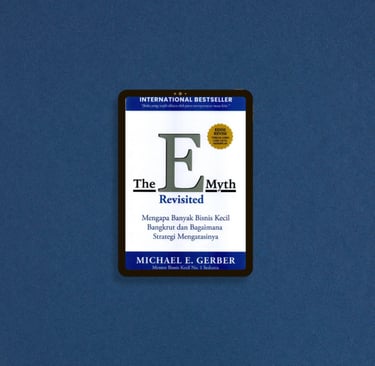
The E-Myth Revised: Why Most Small Businesses Don't Work and What to Do About It by Michael E. Gerber (2009)
BOOK HIGHLIGHTS

The Core Premise: You Have to Change Before Your Business Can
When you systematise how you build your business - not just how you do the work inside it - everything transforms. Gerber calls this the Business Development Process, and it's the engine that keeps a company young and thriving.
But here's the catch: if your business needs to change, you have to change first. If you refuse, the business will never give you what you want. And the first shift is rethinking what a business actually is and what makes it work.
The Three Personalities Inside Every Business Owner
Everyone who starts a business is actually three people crammed into one body: The Entrepreneur, The Manager, and The Technician. The problem is that each one wants to be boss, and none of them wants to have a boss.
The Entrepreneur
The visionary. The dreamer. The one who sees opportunity in everything and lives almost entirely in the future - imagining "what if" and "if when." Entrepreneurs are creative, abstract, restless. They engineer chaos into harmony and have an extraordinary need for control. But they also create havoc for everyone around them, because they move faster than anyone else and treat people as problems that slow down the dream. The way he usually chooses is to bully, harass, excoriate, flatter, cajole, scream, and finally, when all else fails, promise whatever he must to keep the project moving.
The Manager
The pragmatist. The one who buys labelled storage boxes and paints outlines of tools on the garage wall so everything stays in place. Where the Entrepreneur craves control, the Manager craves order. Where the Entrepreneur thrives on change, the Manager clings to the status quo. The Manager sees the problems in events. They build a house and live in it forever. Without the Manager there'd be no planning, no predictability. Without the Entrepreneur there'd be no mess to clean up — but also no innovation. The Manager lives in the past.
The Technician
The doer. Lives in the present. Loves the feel of hands-on work and is happiest when in control of the workflow, doing one thing at a time. Their motto: "If you want it done right, do it yourself." They're suspicious of abstractions and lofty ideas. Thinking isn't work; it gets in the way of work. To the Technician, "the system" feels dehumanising, cold, impersonal and something that violates their individuality. To the Manager, the Technician is a component to manage. To the Technician, the Manager is a meddler to avoid. And both of them blame the Entrepreneur for getting them into this mess.
The Balance We Need
If all three were equally balanced, you'd have an extraordinary individual: the Entrepreneur forging ahead, the Manager solidifying the base, the Technician doing great work. Each getting satisfaction from what they do best, serving the whole productively.
Infancy: The Technician's Phase
Most businesses are built around what the owner wants, not what the business needs. And what the Technician wants isn't growth or change. It's a place to work, free from bosses, doing things their way.
This dooms the business before it starts.
In infancy, you are the business. You're making it, buying it, selling it, shipping it. Ten, twelve, fourteen hours a day. You're the Master Juggler and you love it. Until you start dropping balls. There's more work than one person can do. Customers are relentless. And then you notice that the business has become the boss you thought you left behind.
Gerber's line here is brutal and important: "There's nothing wrong with being a Technician. There's only something wrong with being a Technician who also owns a business."
If your business depends on you, you don't own a business - you have a job. The worst job in the world, because you're working for a lunatic. You can't close when you want, leave when you want, or sell what you've built, because nobody wants to buy a job.
If you want to work in a business, get a job in somebody else’s business - don’t go to work in your own. Because while you’re working and while you’re doing it, doing it, doing it, there’s something much more important that isn’t getting done - the strategic and entrepreneurial work that will lead your business forward, that will give you the life you’ve not yet known.
The purpose of going into business isn't to give yourself a job. It's to get free of one. To create jobs for other people. To expand beyond your existing horizons. To create something that satisfies a need in the marketplace. To live a bigger life.
Adolescence: Getting Some Help
Adolescence begins when you finally get help - always triggered by a crisis. You hire someone, breathe a sigh of relief… and then realise no one cares about the business like you do. No one works as hard, has your judgment, or shares your standards.
So you run back in and start doing everything yourself again, except now you're paying people who are supposed to be doing it.
It's not the people driving you crazy. It's not the complaining customers or the banker or the incorrectly wrapped package. The problem is that you probably change your mind about what needs to be done and how constantly, making it impossible for other people to do it to your satisfaction. And you don't know how to do it any other way. To behave differently, you'd need to wake up the Entrepreneur and the Manager who've been asleep inside you and develop the skills only they can bring. But the Technician won't stop long enough for that to happen. The Technician has to catch the balls.
Beyond the Comfort Zone
Every adolescent business hits a point where it pushes past the owner's Comfort Zone - the boundary where you feel in control.
The Technician's boundary = how much they can do themselves
The Manager's boundary = how many technicians they can supervise effectively
The Entrepreneur's boundary = how many managers they can engage in pursuit of their vision
When the business outgrows the owner's ability to personally touch, feel, and inspect every piece of work, three things can happen:
1. Getting Small Again
The most common reaction. Can't control the chaos? Eliminate it. Get rid of the people, the inventory, the complexity. Go back to doing it all yourself. And then you face the truth: you own a job, not a business. You can neither close it, leave it, or sell it.
2. Going for Broke
Keep growing faster and faster until the business self-destructs under its own momentum. People justify this as "fast track" business, but speed and brilliance have never been enough - someone's always faster and brighter.
3. Adolescent Survival (The Worst Outcome)
You survive through sheer stubbornness. Kicking and scratching every day. Beating up your people, ranting at your family. You keep the business going through raw willpower alone. But you're a twelve-cylinder engine running on one cylinder. Eventually, your business doesn’t explode - you do. There's nothing left.
What Should Happen Instead
Dictate your business's rate of growth deliberately. Understand the key processes, objectives, and market position. Ask: Where do I want to be? When? How much capital? How many people doing what work? You'll be wrong sometimes. You'll change your mind. But you'll have contingency plans. Best case and worst case. And critically: if you don't articulate it (write it down clearly so others can understand it) you don't own it.
Maturity and the Entrepreneurial Perspective
A mature company knows how it got where it is and what it must do to get where it wants to go. The people who start mature companies have a fundamentally different perspective.
The IBM Story
Tom Watson, founder of IBM, was asked what he attributed IBM's success to. His answer (paraphrased): I had a clear picture of what IBM would look like when it was done. I realised that for IBM to become a great company, it would have to act like a great company long before it was one. Every day we modelled the company after that vision, measured the gap between where we were and where we'd committed to be, and set out the next day to close it. Every day at IBM was devoted to business development, not doing business.
The Entrepreneurial Perspective
Sees the business as a system for producing results for the customer - resulting in profits
Asks: "How must the business work?" (not "What work do I need to do?")
Starts with a picture of a well-defined future, then works backwards to change the present
Views the business as an integrated whole - a network of seamlessly integrated components producing a specifically planned result
Every step is measurable. There are standards, articulated rules, a clear recognisable form.
The Entrepreneurial Model
This has less to do with what's done in a business and more with how it's done. The commodity isn't important - the way it's delivered is.
The Entrepreneur surveys the world and asks: "Where is the opportunity?" Then constructs a solution to real customer frustrations. Not from the Entrepreneur's perspective - from the customer's. "How will my business look to the customer? How will it stand out?"
To the Entrepreneur, the business itself is the product. To the Technician, the product is what they deliver. To the Technician, the customer is a problem (they never want what you're offering at the price you're offering it). To the Entrepreneur, the customer is an opportunity - a continuing parade of changing wants waiting to be satisfied.
The Turn-Key Revolution and the Franchise Prototype
At the heart of the Turn-Key Revolution is the idea of building a systems-dependent business, not a people-dependent business. A business that could work without you.
The Franchise Prototype is the working model of the dream. It's where all creative thinking is nursed by pragmatism into innovations that actually work. It's a buffer between hypothesis and action - testing ideas in the real world, not the world of competing theories. The only criterion: does it work?
The system runs the business. The people run the system.
This solves the eternal question: how do I give my customer what they want while maintaining control of the business that's giving it to them?
For the Entrepreneur: a medium for bringing vision into reality
For the Manager: the order and predictability they need
For the Technician: freedom to do the technical work they love
For the business owner: a way to feed all three personalities in balance
Working ON Your Business, Not IN It
Your business is not your life. Or at least it shouldn’t be. They are two separate things. At its best, your business is something apart from you - with its own rules and purposes.
Once you recognise that the purpose of your life isn't to serve your business, but that the purpose of your business is to serve your life - you can go to work on it rather than in it.
The Franchise Mindset
Pretend your business is a prototype for 5,000 more just like it. Perfect replicates. Build it as if you're going to franchise it. This forces you to think in systems.
The Six Rules of the Franchise Prototype
1. Provide consistent value beyond what customers, employees, suppliers, and lenders expect.
Value can be a word said at the door, an unexpected gift, recognition for a job well done, a reasonable price, dedication in explaining products, or a simple thank you to your banker.
2. Be operated by people with the lowest possible level of skill.
If your model depends on brilliant, highly skilled people, it's impossible to replicate. You don't need to hire brilliant practitioners. You need to create the best system through which good practitioners produce exquisite results. The question: how can I give my customer results systematically rather than personally? How can I create an expert system rather than hire one?
People bring systems to life. People who are systems-oriented learn to improve the systems. A system - “a way of doing things” - is absolutely essential to compensate for the disparity between the skills your people have and the skills your business needs if it is to produce consistent results. The system becomes the tool that increases their productivity and differentiates the business from competitors. It's your job to develop those tools and teach your people how to use them.
This is what Gerber calls the Rule of Ordinary People: ordinary people make your job harder, which is the blessing. Because when you build around ordinary people, you're forced to ask the hard questions about how to produce results without extraordinary ones. The typical owner prefers highly skilled people because it seems easier - just leave the work to them. That's Management by Abdication, not Management by Delegation. And it means the business depends on people's whims and moods. It's impossible to produce consistent results in a business that depends on extraordinary people. No extraordinary business tries to.
3. Stand out as a place of impeccable order.
In a world of chaos, people crave order. An orderly business tells customers your people know what they're doing. It tells your people you know what you're doing. It says: while the world may not work, some things can.
4. Document all work in Operations Manuals.
Documentation provides your people with the structure they need and with a written account of how to “get the job done” in the most efficient and effective way. Without it, all routinised work turns into exceptions. It provides structure, a written logic, a technology for producing results. It reduces work to specific, simplified tasks the Technician in each of us needs to understand.
Alvin Toffler's insight: for many people, a job provides structure around which the rest of their lives can be organised. The key word is clear. Documentation provides the clarity that structure needs.
5. Provide uniformly predictable service.
It's not enough to look orderly - you must act orderly. What you do is less important than doing it the same way every single time.
6. Use uniform colour, dress, and facilities code.
Colours and shapes scientifically influence buying decisions. Blue suits outsell brown suits. Triangles produce fewer sales than circles, and crests outperform both. The shape of your sign, logo, and type style on business cards will significantly impact sales whether you think about it or not. Think of your business as a package for your product, which is the business itself.
The Essential Questions
How can I get my business to work without me?
How can I get my people to work without my constant interference?
How can I systematise my business so it could be replicated 5,000 times?
How can I own my business and still be free of it?
How can I spend my time doing work I love rather than work I have to do?
The Business Development Process: Innovation, Quantification, Orchestration
Building your Prototype is continuous. It rests on three integrated activities:
Innovation
Not creativity - action. As Harvard's Theodore Levitt put it: "Creativity thinks up new things. Innovation does new things."
Gerber's examples:
Instead of "Hi, may I help you?" try "Hi, have you been in here before?" - this opens a conversation path either way and connects to a specific programme you've created.
Test clothing: brown suits vs. navy blue suits with red accents. Blue outsells brown consistently. It doesn't matter who's wearing them.
Touch customers lightly on the arm during the sales process. People respond more positively to touch. Measurable increase in sales.
Innovation poses the question: what is standing in the way of my customer getting what they want? It must take the customer's point of view. It should simplify the business to its critical essentials and make things easier for everyone. If it doesn't, it's a complication, not an innovation.
Quantification
How do you know the innovation worked? You measure. Most small business owners can't tell you how many selling opportunities they had yesterday. That ignorance costs a fortune.
To know if changing your greeting produced a 16% increase in sales, you need to track: how many people came in before and after, how many bought, what the average sale value was, and what improved.
Quantify everything. How many customers per day? Morning vs. afternoon? How many calls? How many want a price? How many buy? Which days are busiest? Eventually you and your people think about the entire business in numbers. Without them, you can't know where you are, let alone where you're going. With them, the business comes alive with possibilities.
Orchestration
Orchestration is the elimination of discretion at the operating level. Without it, nothing can be planned or anticipated. If everyone does things their own way, you're creating chaos, not order.
If you haven't orchestrated it, you don't own it. If you don't own it, you can't depend on it. If you can't depend on it, you don't have a franchise. And a franchise - your unique, proprietary, replicable way of doing business - is what differentiates you from everyone else.
The need for orchestration rests on one certainty: people will only do one thing predictably - be unpredictable. The system must provide the vehicle for predictability.
The Cycle Never Ends
Once you've innovated, quantified, and orchestrated something, you must keep doing it. The world won't tolerate a stationary object. It will collide with whatever you've created and destroy it. The Business Development Process lets you preempt those collisions.
The Deeper Point
You can't understand Orchestration stripped of Innovation and Quantification - it becomes routine without purpose. But with the continuous cycle, work transforms from habit into exploration. Each position connects to the function it serves, which connects to the business, which connects to the world. The work becomes a mirror of who you are.
Gerber draws a beautiful parallel to craftsmanship: the apprentice, the craftsperson, the master. The master's role is to teach. They're connected to the apprentice as though to their own past. Mastery means knowing that growth, change, and transformation are always moving, never still.
The Business Development Process is a metaphor for personal transformation. Not efficiency for its own sake. Not "getting lean." But creating more life for everyone the business touches - especially the person who owns it. Quality means nothing without harmony, balance, passion, intention, attention. The work becomes a way of coming to grips with real life, within a structure of your own design.
Your Primary Aim
Before anything else, you must answer: What do I value most? What kind of life do I want? Who do I wish to be?
Your Primary Aim is the answer. It's the script you'd write for your own funeral - what you want to be able to say about your life when it's too late to change it.
And then? Make it come true. Live your life as if it were important. Take it seriously. Create it intentionally.
Without a clear picture of how you wish your life to be, how can you begin to live it? How would you measure progress? How would you know where you are or how far you have to go?
The difference between great people and everyone else: great people create their lives actively. Everyone else is created by their lives, passively waiting to see where life takes them next. Living fully vs. just existing. Living intentionally vs. living by accident.
Questions to Ask
What do I wish my life to look like day-to-day?
What would I like to truly know about my life?
How would I like to be with other people - family, friends, colleagues, customers?
How would I like people to think about me?
What do I want to be doing in 2, 10, 20 years?
What do I want to learn - spiritually, physically, financially, intellectually?
How much money do I need? By when?
These answers become the standards against which you measure progress. Without them, your life drifts aimlessly. Your Primary Aim provides the vision that brings your business to life and your life to your business. It provides purpose and energy.
Your Strategic Objective
Once your Primary Aim is clear, you can design the business that will help you get there. Your Strategic Objective is a clear statement of what your business must ultimately do for you to achieve your Primary Aim.
It's the vision of the finished product - your business. The business is a means, not an end. A vehicle to enrich your life, not drain it.
Your Strategic Objective isn't a business plan. It's a product of your Life Plan. Your Business Strategy and Plan provide the structure for how the business operates over time to fulfil that Life Plan.
Unless your strategy can be reduced to simple, clearly stated standards, it will confuse more than it helps. Your Strategic Objective is a list of those standards - a template, a tool for measuring progress, designed for implementation, not rationalisation.
The First Standard: Money
How big is your vision? You need to know gross revenues, gross profits, pretax and after-tax profits. Can you predict all this from the start? No. But any standards are better than no standards.
The real money question: How much do I need to be independent of work? To be free? Not income - assets.
And ultimately: the only reason to create a business is to sell it. To build it, finish it, and get paid for it. A turn-key solution. A predictable little machine that does what it promises every single time.
The Second Standard: An Opportunity Worth Pursuing
Does this business alleviate a frustration experienced by a large enough group of consumers to make it worthwhile? This defines both what you're creating and who your customer is.
Nobody is buying the commodity. People buy feelings. Peace of mind. Order. Power. Love. Your product is how your business anticipates and satisfies those feelings. Demographics tell you how many opportunities you have. Psychographics tell you how successfully you can satisfy the emotional needs hiding there.
Beyond That
There's no fixed number of additional standards, only questions that need answers. When is the Prototype complete? Where will you operate? How - retail, wholesale, both? What standards will you insist on for reporting, cleanliness, management, hiring, firing, training? The standards you set shape both the business and your experience of it.
Your Organisational Strategy
Organisational development - as reflected in an Organisation Chart - can have more impact on a small company than any other single business development step.
Most small companies organise around people rather than functions. Around personalities rather than accountabilities. The result: chaos.
How to Do It Right (The Widget Makers Example)
Think of the business as a corporation, not a partnership. Separate your role as shareholder (outside the business) from your role as employee (inside it).
Start with your Strategic Objective, then build the Organisation Chart around every position the business will need when it reaches its full potential. Even if it's just you filling every box right now. This describes all the work that needs to be done - and forces you to think about it clearly.
For each position, write a Position Contract - not a job description. It's a contract summarising: the results to be achieved, the work they're accountable for, the standards for evaluation, and a signature line. Accountability literally means "stand up and be counted."
So, even if a business only has one or two people, it helps to design it as if it were already a larger company.
The first step is to identify all the important functions the business needs, such as:
Leadership
Marketing and sales
Operations and delivery
Finance and administration
Customer service
These functions are then turned into specific roles on an organization chart.
Define what each role is responsible for
For every role, create a simple agreement that states:
What results the role is expected to achieve
What the person is responsible for
How success will be measured
The goal is to make accountability clear. Every role should have a defined purpose and expected outcomes.
One role, one accountable person
Some roles can only have one owner. For example, there should be one person ultimately accountable for running the business and making sure goals are achieved.
Multiple people can contribute, but accountability should be clear.
People can wear multiple hats
In a small business, there are usually far more roles than people.
One person might be:
Managing operations
Handling finances
Looking after facilities
Another person might be:
Marketing the business
Selling to customers
Conducting research
The important thing is that all necessary work has an owner, even if one person fills several roles.
Use the structure to spot problems
When all roles are mapped out, it becomes easier to see if the workload is balanced.
If one person is responsible for far more roles than another, responsibilities can be redistributed before problems appear.
Prototyping the Position: Replacing Yourself with a System
Start at the bottom of the organisation, not the top. Work in each position as a Technician while simultaneously working on that position as its manager. Apply Innovation, Quantification, and Orchestration to each role.
Test what works. Quantify the results. Write the best methods into an Operations Manual. Then hire - not an expert, but an apprentice. Someone eager to learn, willing to follow the system, open to developing new skills. Hand them the manual. Train them. And the moment they take over, you move up to manage the system rather than do the work. Note: Hire only when you can fully shift the role to the new person and hand them the complete system.
You shift from Tactical Work to Strategic Work.
The Integrity of It
If you won't follow the rules, why should anyone else? If the rules don't apply to the leader, why would anyone take the game seriously? You must act the same way you expect employees to act, or the system will indulge your preferences rather than serve the business.
Your Management Strategy
The System is the Solution.
Your Management System is designed into your Prototype to produce marketing results. The more automatic it is, the more effective the Prototype becomes. It orchestrates how management decisions are made while eliminating the need for those decisions wherever possible.
Management Development isn't a management tool - it's a marketing tool.
Your People Strategy
The Philosophy
"The work we do is a reflection of who we are. If we're sloppy at it, it's because we're sloppy inside. If we're bored by it, it's because we're bored inside (with ourselves, not with the work). The most menial work can be a piece of art when done by an artist. The job isn't outside of ourselves but inside."
Work is passive without you. It's just an idea until a person does it. And in doing it, you become the creator of its impact on the world. You either breathe life into it or death.
The Idea Behind the Work
What makes a great workplace different: there's an idea behind the work that's more important than the work itself. Everyone who joins is given a choice, not after they've started working, but before. They understand the idea first, then decide whether to commit.
The Game Worth Playing
People don't just want to work for exciting people. They want to work for people who've created a clearly defined structure for acting in the world. That structure is called a game. And nothing is more exciting than a well-conceived game.
The rules of the game symbolise the idea the owner has about the world. If the idea is positive, the business reflects it. The degree to which people buy in depends not on them but on how well you communicate the game at the outset of the relationship, not after it's begun.
Rules for Building the Game
The game comes first; what people do comes second. Don't figure out the tasks and then try to gamify them.
Never create a game you're unwilling to play yourself. They'll find you out.
Create specific ways to win without ending the game. The game can never end (that kills the business), but people need victories along the way.
Change the tactics, not the strategy. The strategy is the moral underpinning. It stays sacrosanct. But change is necessary - any game becomes ordinary eventually.
Never expect the game to be self-sustaining. Remind people constantly. Weekly meetings about the game. Daily attention to exceptions.
The game must make sense. Build on universally verifiable truths. Muddy beginnings get you nowhere.
Plan fun into it - but let your people define what fun means. A game doesn't need to be fun all the time. Part of the thrill is learning to deal with the hard parts while keeping your dignity.
If you can't think of a good game, steal one. But learn it by heart. Nothing worse than pretending.
What People Actually Need
What's missing in most workplaces: purpose, values, worthwhile standards, a sense of relationship. People suffer in isolation. Most of us scramble for distraction (e.g., music, television, things) to fill the emptiness and shore up our eroding sense of self.
What people need is a place of community with purpose, order, and meaning. Where being human is a prerequisite but acting human is essential. Where discipline and will are prized as the backbone of intentional action. Where generally disorganised thinking gets focused on a specific worthwhile result. A place that replaces the home most of us have lost. That's what a business can do.
The Hiring Process (The Hotel Example)
The Boss communicated his idea through documented systems and through his warm, personal manner. The medium was as important as the message.
The hiring process included:
A scripted group presentation of the Boss's idea to all applicants simultaneously: the idea, the history, and the attributes needed
Individual meetings to discuss each applicant's reactions and why they felt suited for the role
Scripted phone notification to the successful candidate
A standard thank-you letter to unsuccessful applicants
First-day training: reviewing the idea, touring the systems in action, demonstrating how people and systems depend on each other, issuing uniform and Operations Manual, reviewing Strategic Objective and Position Contract, completing paperwork
The Hierarchy of Systems
How We Do It Here - every distinct process, documented in Operations Manuals
How We Recruit, Hire, and Train People to Do It Here
How We Manage It Here
How We Change It Here
The "It" is your stated purpose. At Federal Express: getting it there overnight. At Gerber's example bakery: Caring. How do you express caring when you answer the phone? When you take a pie out of the oven? When you take money from a customer? That's "How You Do It Here." Documented. Taught. Managed. Improved upon. Discussed. For as long as you're in business.
Your Marketing Strategy
What your customer wants is probably very different from what you think they want.
How Buying Decisions Actually Work
All customer expectations are ways the unconscious mind gets fed. If the sensory input matches expectations, the unconscious says "yes." If not, "no." And that decision happens instantly.
TV commercial: the sale is made or lost in the first 3-4 seconds
Print ad: 75% of buying decisions are made at the headline alone
Sales presentation: made or lost in the first 3 minutes
After that instant of unconscious decision, the conscious mind assembles rational justification for what's already been emotionally determined. Buying decisions are irrational. When a customer says "let me think about it," they're not going to think about it. They've already decided. They either can't say no to your face, or you haven't given their unconscious mind what it craves.
The Two Pillars
Demographics - who your customer is (age, education, geography, family size, etc.)
Psychographics - why they buy (the unconscious perceptions that drive decisions)
Each demographic group has identifiable psychographic patterns. Women of a certain age, education level, geography, and family size buy for very specific unconscious reasons - different from another group with different demographics. These differences predetermine what each group buys.
Reality only exists in perceptions. "Find a need and fill it" should really be "find a perceived need and fill it." If your customer doesn't perceive a need, they don't have one even if they objectively do.
Marketing as Everything
Every function in the company is a marketing function if you ask: "What must our business be in the mind of our customers for them to choose us over everyone else?"
The entire business process is a marketing process:
Lead Generation - the promise you make to attract them
Lead Conversion - the sale you make once they arrive
Client Fulfilment - delivering on the promise before they leave
Your Systems Strategy
A system is a set of things, actions, ideas, and information that interact with each other - and in doing so, alter other systems. Everything is a system.
Three Kinds of Systems
Hard Systems - inanimate things. Computers, colours, physical spaces.
Soft Systems - living things or ideas. People, scripts, selling processes.
Information Systems - data about how the other two interact. Inventory control, cash flow forecasting, sales reports.
The innovation, quantification, orchestration, and integration of all three is what the Business Development Programme is about.
The Purpose of a System
To free you. A well-designed Hard System produces results without anyone paying attention to it - leaving you free to do what you actually care about.
The Selling System (Soft System Example)
A selling system follows six steps:
Identify specific benchmarks (consumer decision points) in your selling process
Literally script the words for each benchmark (written like a play)
Create the materials for each script
Memorise each script
Deliver each script identically every time
Free your people to communicate more effectively - articulating, watching, listening, understanding, engaging each prospect fully
Structure vs. Substance
Structure = what you do (predetermined elements, exact words, materials, what you wear)
Substance = how you do it (what you bring - how you say it, how you are when you say it)
Together they produce better results than any individual salesperson left to their own devices.
The Power Point Selling Process
A series of scripted interactions:
Appointment Presentation - one purpose: make an appointment. Move the prospect to the next step. Speak about the product (the feeling/result), not the commodity.
Needs Analysis Presentation - reestablish emotional commitment, establish credibility through a Positioning Statement ("We are X Specialists"), describe your system and why it works, complete a questionnaire, provide promised information, and schedule the next meeting.
Solutions Presentation - the easiest step if you've done everything else well. The sale is already made emotionally. This just provides the rational armament for the emotional commitment. Review everything and present solutions.
The key: do the process the same way every single time. Same words, same method. Then you don't have a selling person - you have a selling system.
The Information System Tracks It All
For every step, track: calls made, prospects reached, appointments scheduled/confirmed/held, analyses scheduled/confirmed/completed, solutions presented/confirmed/completed, sales closed, average dollar value. This tells you what you need to know to develop, control, and change your selling system - and every other system in the business.
Information is the glue that holds your Systems Strategy together. It tells you when and why you need to change.
Everything Is Interdependent
Your Primary Aim, Strategic Objective, Organisational Strategy, Management Strategy, People Strategy, Marketing Strategy, and Systems Strategy - all of them are totally interdependent. Not one of them works in isolation.
The Final Message
A small business is a place that responds instantly to any action you take. A place to practice implementing ideas in ways that change lives. A place to test assumptions about yourself.
The Entrepreneurial Revolution is a flight from the chaos "out there" into a world of your own. A yearning for structure, form, control. And something more personal: a relationship with yourself and the world that's impossible to experience in a job.
But most small businesses fail. Because we bring our chaos with us. We don't change. We try to change "out there." We try to change the world by starting a business, but we stay the same. And so the business that was meant to give us freedom becomes the worst job in the world.
We can't change our lives by starting "out there." We can only change by first understanding how our world is constructed, how it works, and the rules of the game. A small business is a world small enough to study and a Business Development Programme is the means to study it effectively.
Innovation, Quantification, and Orchestration become a practice that reveals your limits, weaknesses, and strengths. They show you what actually works, not what you imagine should work.
The gap between where your business is and where you want it to be is always created by the absence of systems. The absence of a proprietary way of doing business that differentiates you from everyone else. Find the gap, build the systems, close it.
Your business can become a symbol for the life you wish to live. A visible manifestation of who you are and what you believe. A living testament to your will.
© Copyright LINA MILESKAITE 2026
Get in touch