
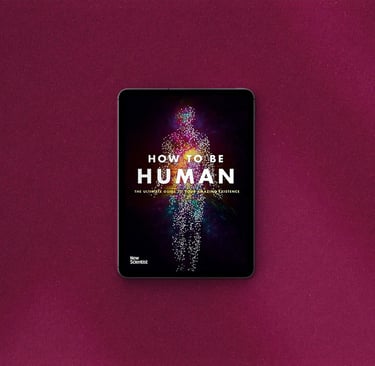
Some New Things I Learned From The Book "How To Be Human"
BOOK HIGHLIGHTS

Where Does Morality Come From? 🔍
We learn the social rules of our culture, and they become linked in our brains with emotions such as pride, honour, shame, and guilt. Selfishness may be in our interest, but it’s associated with negative emotions, whereas virtue prompts positive ones.
Our oxytocin levels increase when we trust someone, and people with higher oxytocin levels tend to be more generous and caring.
Just as almost all of us are capable of altruism, we’re also capable of evil, from bullying and corruption to torture and terrorism under certain circumstances. The upshot of this is that good and evil are two sides of the same coin. Evolution has made us both, and we can’t have one without the other.
The Strange Nature of Belief 👻
Our beliefs come from 3 main sources: our evolved psychology, personal biological differences and the company we keep.
Our brains are built to see patterns and assume someone or something is behind events. This made sense for our ancestors - if they heard rustling in the bushes and thought “probably nothing,” they would get eaten. So, it’s better to assume a predator was there, even if they were wrong most of the time. We inherited brains that look for invisible forces causing things. Random bad luck feels like it needs an explanation, whereas good fortune feels like someone’s looking out for us. We’re wired to see purpose and agency everywhere, which is exactly what religion provides.
We can and do change our beliefs when we receive enough contradictory evidence and are presented with a powerful moral argument. And if we’re put in a different social circle, our beliefs can shift completely. When we change our minds, we also reshape the facts to fit with our new beliefs.
Interestingly, we don’t need to be indoctrinated to believe in gods. Religious belief is the default path of the human mind.
Building the Self From Scratch 🪁
Psychologist Ulric Neisser’s influential theory of the self breaks down our selves into five elements:
The ecological self - it’s what distinguishes us from others, gives us a sense of body ownership and an individual point of view.
The interpersonal self - underlies self-recognition and allows us to see others as agents like us and have empathy for them.
The temporally extended self - endows us with awareness of our personal past and future.
The conceptual self - the idea of who we are: a being with a life story, personal goals, motivations and values.
The private self - our inner life, stream of consciousness, and awareness of it.
Our self can be divided into 2: “I” - that comprises the experience of being, and “me” - the set of ideas we have about ourselves.
Why We’re Good at Everything 💁♀️
If we ask people to rate themselves on any positive trait, such as competence, intelligence, honesty, originality, friendliness, and reliability, most people put themselves in the better-than-average category. If we ask them about negative traits, they will rate themselves as less likely than average to possess them.
The delusion that we’re above average at almost everything isn’t something we reserve for ourselves. We also inflate our opinions of people we care about and love. Around 95% of people rate their partner as smarter, more attractive, warmer, and funnier than average. Parents of small children almost universally rate their children as cleverer, cuter, and more developmentally advanced than their peers.
Is Our Physique Unique? 🌱
We are a physical specimen like no other (there are no two people with the same fingerprints, iris structure, or ears). However, our face attributes are much less distinct than we think. It turns out that the world is full of our doppelgangers. One analysis of several thousand faces found that 92% of them had at least one lookalike that both humans and facial recognition software struggled to tell apart. So even though we’re unique, our face is not.
What Does Our Body Language Say About Us? 🔥
Many tricks can help make the right first impression. E.g., people in job interviews who sit still, hold eye contact, smile, and nod along with the conversation, are more likely to be successful in winning the role.
Those people whose gaze wanders or who avoid eye contact, keep their head still, and don’t change their expression much, are more likely to be rejected.
“Mirroring” - subtly copying another person’s gestures as we interact with them - is a very good way of building rapport.
Our body language can also influence how we feel. E.g., power posers showed elevated testosterone and decreased cortisol. Sitting up straight can bring positive emotions, while hunched shoulders lead to feeling down. Similarly, faking a smile makes us feel happier, while frowning has the opposite effect.
Does Our Voice Reveal Secrets About Us? 👄
For both sexes, a deeper voice is widely assumed to mean greater competence and leadership abilities. Among male executives of US companies, for example, those with deeper voices tend to run bigger firms and earn over $150,000/year more than men with higher-pitched voices!
Women’s voices are judged similarly - people generally prefer women politicians with deeper voices.
Moreover, many tend to mistrust people with thick accents that are harder to understand.
Smart Thinking Needs a Body 🗯
Stress is the enemy of creativity. People solve anagrams in about 10% less time when lying down (relaxing) than when standing.
There are other ways to get creative juices flowing:
- Bend our right arm at the elbow, resembling Auguste Rodin’s statue “The Thinker”, as it helps perform better creative-thinking tasks, where we need to find innovative uses for everyday objects.
- Lateral eye movements can also temporarily encourage communication between the right and left hemispheres of the brain, boosting creativity.Alcohol may be the enemy of focused attention, but focus can be the enemy of creativity… you’d assume, then, that alcohol should help our creativity flow. And you’d be right! When researchers got a bunch of students tipsy on vodka and cranberry and asked them to solve some tricky word puzzles that required creative solutions, they solved them faster and in greater numbers than those who were given soft drinks.
Can We Escape The Metabolism Prison? 🏃♂️
We need energy to function. Any excess energy is stored in one of two forms: glycogen in the liver and muscle (or fat, when that store is full).
The tempo of cell metabolism (our metabolic rate) is controlled by hormones released by the thyroid gland, which sits at the front of the neck. People with an overactive thyroid eat lots, get very hot, and are very thin. In contrast, those with an underactive thyroid eat less, become cold, clammy, and gain weight. These disorders affect about 1 in 1,000 men but are more common in women, with 1 in 100 suffering from overactivity and 15 in 1,000 with an underactive thyroid.
A resting obese person will expend more energy than a lean person, but they also have more cells to maintain! A kilogram of fat cells burns 4 calories a day. The same mass of muscle burns a modest 13 calories a day. Obese people tend to have larger organs, which is another reason their energy expenditure is higher.
Genes can and do influence our tendency to gain weight. Scientists have identified 5 traits that reliably predict greater weight gain, which include poor fitness, low muscle mass, low levels of testosterone, being less responsive to leptin (the appetite-suppressing hormone), and burning less fat as fuel when digesting food and absorbing its nutrients.
How Can Fat Make Us Thin? 🌶
Capsaicin, the substance that gives chillies their burn, was found to stimulate brown fat in a similar way as exposure to cold. Men who take a daily dose of capsaicin can boost their brown-fat activity and burn more calories. It’s good because capsaicin is cheap, relatively safe, and can be grown to order. But more tests need to be run to prove its effectiveness.
What’s Going Through Our Minds? 🧠
60+% of us experience “inner speech”, where our everyday thoughts can lead to a proper back-and-forth conversation!
Between 5-15% of us hear outside voices, even if only fleetingly or occasionally, whereas about 1% of people with no diagnosis of mental illness hear recurring voices. Around the same proportion of the population is diagnosed with schizophrenia, challenging the assumption that the two are related. Scans reveal little difference between the brains of those who haven’t been diagnosed with mental illness, but do hear voices, and those who don’t hear voices.
Women tend to have better episodic memories than men. With semantic memory, men tend to remember spatial information better, whereas women generally perform better at verbal tasks, such as recalling word lists. Personality seems to be a factor too - people open to new experiences tend to have better autobiographical memory.
If you’re delusional, can’t concentrate for more than 8 seconds, forget people’s names as soon as you’re introduced, and can’t stop thinking about sex or food, then you can be glad that you’ve a very normal human mind. :)
Are We In Charge of Ourselves? 👋
The unconscious is the place where snap judgements are made. If we’ve ever fallen in love at first sight or decided not to trust a random stranger we’ve just met, that’s our unconscious mind doing its thing. Surprisingly, these snap judgments are often pretty accurate.
Experiments show that we can judge somebody’s confidence, economic success, and political affiliations after seeing them for just 2 seconds. Pretty wild, right?
Another interesting discovery is that non-conscious thinking works better in situations where we imagine rational, conscious thought to be best. People who have to make difficult choices based on hard-to-compare information, such as which apartment to rent or mobile phone contract to select, often do better if they don’t actively think about it. It seems the unconscious does a better job of weighing up the pros and cons in the background.
Why Are We Prone to Bad Habits? 🤦♂️
Unfortunately, our brains don’t distinguish between good and bad habits. Evidence for this comes from studies of willpower. Willpower was found to come in a limited supply - the more we use it during the day, the more it gets depleted, which means we’re more likely to give up on later attempts. When willpower is depleted in times of stress or exhaustion, we fall back on habits, whether good or bad. However, it’s like a muscle - and although it can get depleted, it can also get stronger with practice.
Certain cues or environments can also trigger habits. If we give people popcorn while watching videos in either a cinema or a conference room, then they’ll generally eat more popcorn in the cinema, even if the popcorn is stale. It could be environmental cues that trigger our brain signals, telling the striatum to initiate that habitual behaviour.
It takes more than 10 weeks to form new habits, but once we have made one, it can persist for a lifetime.
How Smart People Can Be Stupid? 🎈
RQ measures Risk Intelligence, which defines our ability to assess probability. We tend to overestimate our chances of winning the lottery and underestimate the chances of getting divorced. Poor Risk Intelligence can cause us to choose badly without understanding that we’re doing so.
People with high RQ have acquired strategies that boost self-awareness. To avoid making bad decisions, we can take our intuitive answer to a problem and consider its opposite before making the final decision. This can help develop a keen awareness of what we know and don’t know.
Why We’re All Biased? 🎭
We seek out information that fits with our beliefs and ignore or dismiss information that doesn’t. This confirmation bias has been repeatedly shown in experiments in which people are asked to read a range of evidence about a contentious topic, such as capital punishment. Even when exposed to arguments on both sides, most people interpret the evidence in a self-serving way, accepting the data that supports pre-existing views and dismissing or ignoring the rest.
How Does Friendship Work? 🥰
Many species form and maintain social bonds through grooming. In animals, this takes the form of physical grooming, while in humans it often appears as light touch or stroking. These behaviours trigger the release of endorphins in the brain, creating feelings of relaxation, trust, and social closeness.
As social groups grow larger, individuals must spend more total time maintaining relationships, but they are able to bond with fewer people at a time. To manage this, humans developed behaviours that trigger endorphin release more efficiently across groups rather than one-to-one interactions. Three such behaviours are particularly effective:
- Laughter – typically shared in small groups (around three people), making it more efficient than bonding with individuals one at a time.
- Singing and dancing – allow bonding with even larger groups simultaneously.
- Language – enhances these processes by giving greater control over laughter through jokes, stories, songs, and coordinated movement.Even though we can feel a connection with a super-group consisting of thousands, most of us have no more than 150 in our personal social network. About half of these are our family, which stays constant throughout life. But non-kin friendships are susceptible to decay if we do not invest in them. Failure to spend time with friends for a year reduces the quality of that friendship by about one-third.
Friends with Benefits For Mind and Body 💓
Social isolation creates feelings akin to physical pain and leaves us stressed and susceptible to illness. For humans, friends are not an optional extra - we’ve evolved to rely on them. Like anything that we need to survive, friendship is driven by a system of reinforcement and reward. Being friendly is linked with the release of neurotransmitters in the brain and biochemicals in the body that make us feel good.
People were found to be as genetically similar to their non-kin friends as they would be to fourth cousins! One of the mysteries of friendship has been why we cooperate so readily with complete strangers, and this similarity explains it - perhaps we should think of our friends less as strangers and more as “facultative relatives”.
The Unseen Impacts of Brothers and Sisters 🌱
A growing body of research reveals that our position in the pecking order can affect our lives in various ways. For example, firstborns tend to be more intelligent than their siblings. They also tend to be taller by about 2.5cm. But they are less responsive to insulin than their siblings and tend to have significantly higher blood pressure, which puts them at a substantially higher risk of developing type-2 diabetes, heart disease, hypertension and stroke.
Firstborns and lastborns tend to have the closest relationships with their parents, while middle children develop stronger ties outside of the family. This might be because middle children tend to receive less parental attention and so they look elsewhere for friendship.
Younger siblings were found to be more likely to take part in dangerous sports.
Lastborns tend to be politically adventurous.
Later-borns are more likely to take up revolutionary causes than firstborns when it comes to leadership or politics.
A number of studies have also shown that the more older brothers a man has, the more likely he is to be gay.
Finally, the more older siblings a person has, the more likely they are to commit suicide. This effect is larger in women. It may be because firstborns have their parents’ full attention for the first few years of life, which helps them develop stable personalities that are more resilient to stress later in life, whereas later siblings may not be so lucky.
Why You Should Sniff A Potential Partner 👃
Studies show that women prefer men who smell dominant, especially when women are on their most fertile stage of their menstrual cycle. Women can also somehow smell men with more symmetrical bodies (which indicates a man’s ability to withstand infections and other environmental stresses).
Men tend to prefer the scent of women who are ovulating. Women show few external signs of ovulation, but their scent seems to give the game away. Conversely, they find women who are menstruating less appealing.
Research shows that we favour the smell of people of the opposite sex whose MHC genes are very different from our own. This preference may have originated to avoid inbreeding when humans lived in small groups, or as a way to give children the widest variety of MHC genes, and hence the broadest immune protection.
Yeuuuuugghhhh! 😣
There’s experimental evidence that inducing disgust can cause people to shun minority groups, temporarily at least. Perhaps it’s no surprise, then, to find that the more “disgustable” we are, the more likely we are to be politically conservative. Similarly, the more conservative we are, the harsher our moral judgements become in the presence of disgust stimuli.
Given that disgust influences our judgment of right and wrong, others have considered whether it might play a role in the courts, and it appears that it does! Experiments show that it could cloud a juror’s judgement more than anger, and it’s difficult for them to take into account mitigating factors. In courts, disgusting crimes can attract harsher penalties, too.
The Three Pillars Of Emotional Wisdom ⛲
There are ways to improve our regulation skills. “Reappraisal” involves trying to put ourselves in someone else’s shoes so as to be more objective, and change our emotional response accordingly.
Another way is mindfulness - observing the coming and going of our emotions without action or judgement. This strategy has been linked with increased job satisfaction and reduced emotional exhaustion. Seeing emotions as thoughts and sensations provides a sense of perspective, and the “hot” aspect of emotions dissolves.
Teaching Old Dog New Tricks 🐶
The key to a spry mind in later life can be as simple as a walk in the park or some other form of gentle exercise.
Poor physical fitness can be as damaging to our brains as it is to our sex appeal, reducing the long-distance connections between neurons and shrinking the hippocampus, which is involved in learning and memory.
The decline can be reversed by exercise, as it restores the hippocampus, long-range connections, and improves attention, which helps us learn new skills.
It’s best to rotate quickly through the different skills we practice without lingering too long on each one - it seems like jumping between skills makes our mind work a little harder, which helps retain the knowledge in the long term.
The Upside of Old Age 👴
Secrets of a long “health span” include diet, exercise, psycho-spiritual well-being, and social connectedness.
Around 70% of longevity is due to these non-genetic factors, all of which are possible to cultivate.
Another way to avoid the ravages of old age is to keep mentally active.
Does Having Kids Make Us Happier? 👶
Study after study suggests that having children doesn’t make people happier, but frequently even reduces it.
Becoming a parent is often associated with depression and sleep deprivation, leaving couples less satisfied with their sex lives, and can accelerate marital decline.
One study of more than 14,000 couples found that mothers experienced a sharp rise in stress after childbirth - three times higher than fathers - and that this stress continued to increase year on year.
In the United States, mothers rank childcare 16th out of 19 daily activities in terms of positive feelings, placing it just above commuting and work itself. Another study found that the average drop in happiness following the arrival of an infant is greater than that caused by divorce, unemployment, or even the death of a spouse.
That said, happiness and children are not mutually exclusive. One study found that having children increased happiness for men, but not for women - possibly because many of these men were married, and marriage itself has been shown to boost men’s happiness.
Interestingly, the happiest parents tend to be over forty and live in former socialist countries such as Russia and Poland, where care for the elderly largely falls to families.
By contrast, parents aged twenty to twenty-nine experience the greatest decline in happiness after having children. However, generous welfare systems in countries such as Sweden, Japan, and France appear to soften this impact.
Overall, parenthood seems to be something of a lottery. Those who are married, financially secure, and living in countries with strong social support systems are far more likely to find the experience an enjoyable one.
Protecting Our Brain From The Ravages of Time ⌛
One of the strongest predictors of cognitive ability at age fifty-three is educational attainment at twenty-six. Education during the teenage years and early twenties can have a lasting impact on mental skills, shaping cognitive health well into later life. It may also train the brain to recruit alternative neural networks - an ability that plays a key role in building cognitive reserve.
Education is not the only factor that strengthens this reserve. A history of mentally demanding work also offers protection: intellectually stimulating jobs have been shown to reduce the risk of dementia and Alzheimer’s disease. Activities such as crosswords and puzzles help keep the mind agile, while reading has been found to lessen the severity of Alzheimer’s symptoms.
Physical activity adds another layer of benefit - exercise not only slows cognitive decline but can actively improve memory.
This matters because after the age of sixty-five, the risk of dementia roughly doubles every five years. By age eighty-five, around one-third of people are affected.
Blue Brain, Pink Brain 🧠
Boys are more vulnerable to neurodevelopmental conditions such as Asperger’s syndrome, dyslexia, and ADHD.
Major depression is around twice as common in women, while men are more prone to alcohol dependence and antisocial personality disorder.
The amygdalae, which play a key role in processing fear and aggression, tend to be larger in men, whereas the hippocampi, essential for memory, are typically larger in women.
However, brain imaging studies reveal that very few individuals possess a distinctly “male” or “female” brain. Instead, most people show a mosaic of characteristics associated with both sexes. As a result, knowing whether someone is male or female is a surprisingly poor predictor of behaviour, personality, or cognitive ability.
On Dating 🦚
Just as a peacock displays its ornate tail to attract mates, humans have evolved their own courtship rituals through clothing choices, conversation styles, and flirting techniques - all designed to signal reproductive fitness.
Research reveals that both men and women rate potential partners wearing red as more attractive and of higher status, with men responding by sitting closer and asking more intimate questions.
Interestingly, women show greater interest in men who appear “taken,” rating them more highly when they’re seen with a partner or admired by other women. This is opposite for men, though, as they rate women surrounded by men as less appealing.
Intelligence and humour prove more effective than crude remarks, though the most successful approach depends on personality: extroverts respond better to wit, while those seeking casual connections prefer risqué compliments.
Animated facial expressions and body language also boost attractiveness, regardless of what’s actually being said.
While flirtation styles range from “traditional” (where men lead) to “playful” (superficial and fun) or “polite” (cautious), research suggests that “physical” and “sincere” approaches (characterised by flirtatious body language and genuine emotional connection, respectively) tend to lead to the most meaningful relationships.
Why We Differ So Much 👀
Evidence shows that a stressful home life (e.g. absent parents or conflict) can lead girls in particular to breed earlier and more often.
Men are also influenced by upbringing. Those who dismiss attachment (who think they’re important and others aren’t worthy of investment and trust) tend to have higher sociosexuality. Such insecurity is thought to arise from stress during childhood caused by unresponsive or erratic caregivers.
The archetypal promiscuous man scores high on extroversion (which gives a desire to chase), low on neuroticism (which means they don’t worry how his behaviour comes across), and fairly low on agreeableness (which means he doesn’t care about the social consequences of his actions). Similarly with women, but “openness” for them also seems to count.
Testosterone also makes a difference - happily married men and fathers appear to have lower levels of testosterone than other men, while married men on the hunt for extramarital sex have higher levels.
Status seems to affect women’s choice of sexual partner. Women who have more control over their finances tend to place higher importance on physical attractiveness in a man than on his financial prospects.
Food Advice To Be taken With A Pinch Of Salt 🧂
People don’t need to drink 8 glasses of water because they get water from food. The body is officially dehydrated when blood concentration rises by 5 per cent - we feel thirsty after just 2 per cent rise. Just drink when you feel like it!
Antioxidant supplements do not improve health benefits. Some studies even suggest that they can be harmful. E.g., beta-carotene, vitamin A, and vitamin E have been linked to increased mortality. Just follow a relatively healthy diet!
Being seriously obese is very bad for our health, but carrying just a few extra pounds may actually deter the Grim Reaper. Being “overweight” (having a body mass index (BMI) of 25 to 29) brings a 6 per cent reduction in death risk compared with people whose BMI is between 18.5 and 25.
The Astonishing Benefits of Exercise 🏃♀️
Whether it’s running a marathon or walking around in our room, exercise has the potential to prevent more premature deaths than any other single treatment. There’s probably not a single organ in our body that is not improved by it.
A lack of cardio-respiratory fitness has been found to be the most important risk factor for early death. A prescribed weekly dose of exercise (150 minutes of moderate aerobic activity such as brisk walking, ballroom dancing, gardening, or 75 minutes of more vigorous cycling, running, or swimming) has been found to cut the risk of premature death through heart disease by 40 per cent, approximately the same reduction as taking the cholesterol-lowering drugs.
Physical activity also reduces some risks of developing cancer - it halves the risk of breast cancer in women and lowers bowel cancer risk by around 60 per cent.
Faster Body = Faster Mind 🤯
Sedentary adults who exercise aerobically over several months improve their ability in cognitive exercises that need executive control - the kind of control that enables us to change between tasks without making errors. It’s the key ingredient of greater general intelligence.
Over fifty-five-year-olds who don’t exercise tend to have poorer cognitive functions (such as memory and learning skills) than contemporaries who swim, garden, or cycle a few times per week. Middle-aged people who exercise at least twice a week cut their risk of developing dementia in their sixties and seventies.
In young men, cardiovascular fitness correlates well with intelligence and is a good predictor of educational achievement later in life.
Fit people tend to have lower blood pressure, and being fit also cuts the risk of developing Alzheimer’s disease.
The US government recommends that children from six to eighteen years of age do at least 60 minutes/day of aerobic exercise because it keeps not only their bodies in peak condition but also their brains. The same reasoning applies to adults - new exercise regimes that typically last for six months or more tend to increase brain processing speed and improve memory and attention.
Today, the thinking is that a healthy brain is impossible without a highly active body. In other words, exercise is not an enhancer of normal cognition, but a necessity.
Aerobic exercise doesn’t need to be strenuous to work. Walking briskly a few times a week can work just as well. But if we’re already fit, high-intensity interval training (HIT) can take it to the next level.
The Disturbing Truth About Sitting Down 🪑
Sitting down on our butt is bad for us, even if we exercise. Heading to the gym or going for a run is not a license to spend the rest of the day sitting. People who spend hours sitting have a higher mortality rate, even if they workout for 45 to 60 minutes a day! 😯
Somebody who spends 6 hours a day watching television (sitting) can expect to die 5 years younger than somebody who doesn’t. The harm comes primarily through inactivity itself, and so other kinds of inactivity may be just as harmful. E.g., people who sleep more than 9 hours a day are at a greater risk of dying!
We need to break up our sitting with brief but frequent bursts of light activity. That means raising our metabolic rate to just 1.5 times its resting rate, which is actually very easy to do: just standing up and walking around is more than enough. Laboratory studies suggest that doing this for 2 minutes every 20 minutes is sufficient to wipe out the negative effects of extended sloth.
How To Think Yourself Healthy 🍎
Based on what we’ve learned about the placebo effect, there’s a good reason to think that talking to our pills can make them work. Why? Because the way we think and feel about medical treatments can dramatically influence how our bodies respond.
For a wide range of conditions, from depression to Parkinson’s, osteoarthritis, and multiple sclerosis, it’s clear that the placebo response is far from imaginary. Trials have shown measurable changes such as the release of natural painkillers, altered neuronal firing patterns, lowered blood pressure or heart rate, and boosted immune response, all depending on purely psychological cues.
Many researchers who work on the body and mind connection think that what really matters is having a sense of purpose in life. Having an idea of why we’re here and what’s important increases our sense of control over events, rendering them less stressful.
One study of a three-month meditation retreat found that the physiological benefits correlated with an increased sense of purpose in life. The participants were already keen meditators, so the study gave them lots of time to do something important to them. Simply doing what we love, whether it’s gardening or voluntary work, might have a similar effect on health.
Positive thoughts: another way we can boost our health is to give ourselves a pep talk. Think positively and tell ourselves that everything will be fine. Realism can be bad for our health, and optimists recover better from medical procedures, have healthier immune systems, and live longer.
Positive beliefs also help to quell stress, and some researchers believe they also make us feel safe and secure. The belief that things will turn out fine encourages the body to put resources into growth and repair.
Moreover, just as helpful as taking a rosy view of the future is having a rosy view of ourselves. High “self-enhancers” (people who see themselves in a more positive light than others see them) have lower cardiovascular response to stress, lower baseline cortisol levels, and recover faster. Good news is that whatever our natural disposition is, we can train ourselves to think more positively, and it seems that the more stressed or pessimistic we are to begin with, the better it works.
Being social: people who have rich social lives and warm, open relationships live longer and don’t get sick as frequently.
Our attitude towards others can also have a big effect on our health. Being lonely increases the risk of everything from heart attacks to dementia, depression and death, whereas people who are satisfied with their social lives sleep better, age more slowly, and respond better to vaccines.
Meditation: trials looking at the effects of mindfulness meditation suggest that it reduces physical symptoms such as pain, anxiety, depression, and fatigue. There’s also some evidence that meditation boosts immune response in vaccine recipients and people with cancer, soothes skin conditions, and even slows the progression of HIV. Meditation probably works largely by influencing stress-response pathways. People who meditate have lower cortisol levels, and they‘ve changes in their amygdalae, brain structures important in fear and the response to threat. Positive structural changes in the brain associated with meditation can be gained after as little as 11 hours of training. It’s even possible to do short mini-meditations throughout the day, taking a few minutes at our desk to focus on our breathing.
Mesmerising: most clinical trials involving hypnosis are small, but they suggest that it may help pain management, anxiety, depression, sleep disorders, obesity, asthma, and skin conditions such as psoriasis and warts.
How To Shake Off That Feeling of Fatigue 🐱🏍
A sedentary lifestyle, regular stress, and poor diet have all been linked to chronic fatigue. Some studies showed that this fatigue can be reduced by exercising regularly and eating more fruits and vegetables that contain high levels of polyphenols. Iron supplements can also provide an energy boost, even in people without clinical iron-deficient anaemia.
The fatigue can make certain people feel depressed so the advice here is to not let it stop us from doing what we enjoy. It’s well worth forcing ourselves to keep at it because a potent reward could trigger the release of dopamine in brain areas linked to motivation and alertness. Alternatively, we can also do something stressful - the release of adrenaline can also help overcome lethargy.
How Much Sleep Do We Need? 💤
Almost all physical and mental processes are boosted by good sleep and negatively impacted by the lack of it. Sleep is one of the most important pillars of health, more important than diet and exercise!
Poor sleep is associated with memory impairment, emotional dysregulation, and poor decision-making. It affects our immune system, appetite, and has been linked to metabolic diseases such as obesity and type 2 diabetes. Increasingly, lack of sleep is implicated in mental health problems, such as depression, bipolar disorder, schizophrenia, and neurological conditions such as Alzheimer’s disease.
Sleep requirement varies widely from person to person and is largely genetic. It also changes as we age. However, US National Sleep Foundation recommends 7 to 9 hours of sleep for adults, but with a leeway of an hour either side to account for natural variation.
However, there is such a thing as having too much sleep. Regularly getting more than 8 hours of sleep increases our chances of dying, and its association with mortality is at least as strong as sleep deprivation.
Only a tiny minority of us, probably less than 3 per cent, can get by on 6 hours of sleep or less with no problems at all. Sleeping for just 4 hours at night for several nights in a row can lead to high blood pressure, increased levels of cortisol, and insulin resistance. It also suppresses the immune system.
Repaying our sleep debt: when a long sleep is impossible, napping can compensate for sleep debt. A nano-nap, lasting just 10 minutes, can boost alertness, concentration, and attention for up to 4 hours. Double it, and we increase our powers of memory, too.
On the flip side, napping doesn’t provide the benefits of deep sleep, which gives the biggest boost to learning. If that’s the aim, we can opt for a nap of between 60 to 90 minutes, which gives time to go through a full cycle of sleep.
Being aware of blue light: using a screen for 2 hours in the evening significantly reduces melatonin concentration, which makes it harder to fall asleep. It was also found to suppress REM sleep, which is important to memory and emotional regulation.
Staying cool: Melatonin cools the body by a couple of degrees while we sleep, and an overheated bedroom can interfere with this process.
Alcohol is also an enemy of good sleep - having a few drinks before bed disrupts slow-wave sleep, adding a shot of alpha brainwaves that usually only present during wakefulness.
© Copyright LINA MILESKAITE 2026
Get in touch